The Registration Certificate (RC) Transfer in India involves a structured procedure for used cars in India. The process involves filling out an online application through the Parivahan portal, followed by completing forms 29 & 30, and then uploading the necessary documents, such as your RC, insurance, PUC, ID, and paying the required fees. Once all this is done, you are then required to submit the original signed forms and documents to the Regional Transport Office (RTO). After completing the process correctly, a new RC will be issued in your name for your used car, but the process requires both parties participation. This blog is your step-by-step guide for the RC transfer process in India.
What is RC Transfer?
The RC or Registration Certificate of a vehicle is basically a legal proof of ownership of any vehicle. When used cars are sold, the seller must transfer the ownership of the car to the buyer. This process is done by the vehicle RC transfer through the governments Parivahan portal or RTO. If one fails to get the RC transferred for a used car, then legally the owner of that old car is still the seller, even when the buyer has paid the seller.
RC Transfer Process in India
The RC Transfer process in India can be confusing for many people, but understanding it is a must after you purchase a used car. The following are the steps to follow for transferring RC seamlessly in India:
- Visit the Parivahan Portal and hover over Online Services.
- From the Online Services tab, click on Vehicle Related Services.
- Now, choose your State and the relevant Regional Transport Office (RTO).
- Then, enter the details about your vehicles registration number, chassis number, mobile number, and verify the One-time password (OTP).
- Then an application form would appear where you are supposed to fill in the buyers details and upload all the required documents.
- The RTO Transfer fee is then required to be paid online.
- Download the auto-generated form 29 and 30 and get the print signed by both the buyer and seller.
- The signed forms are then to be submitted to the RTO along with your original RC, insurance, PUC, ID Proofs, and other relevant documents.
- After the verification of the documents, a new smart card RC will be mailed to you within a few weeks.
Fee Component | Amount () |
Transfer of Ownership | 300 |
Smart Card Fee | 200 |
Postal Charges | 30 |
Total Fee Payable | 530 |
This is the standard fee structure for RC ownership transfer for four-wheelers and may slightly vary based on State RTO norms or any additional services.
Required Documents for RC Transfer
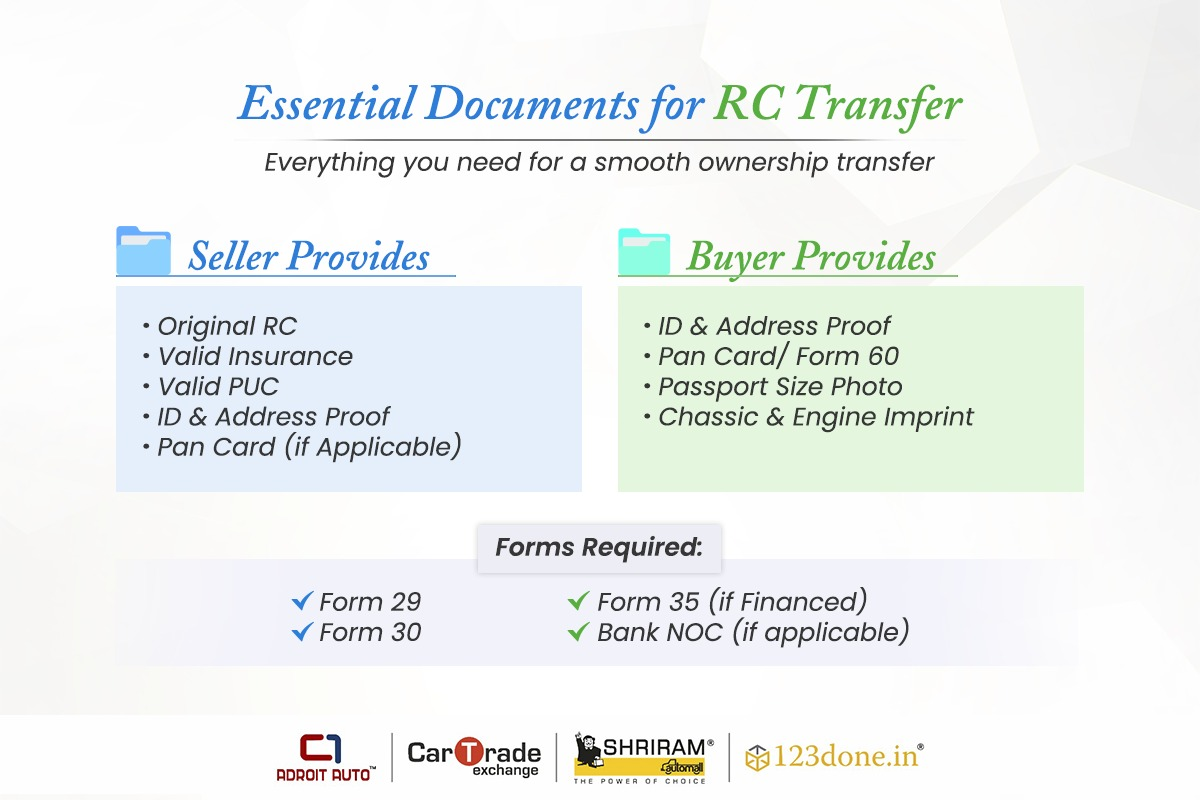
Having the right documents is essential for the RC Transfer process in India for used cars. There are several documents required from the seller and the buyer. The seller is required to have the original vehicle RC, a valid PUC, ID proof for address verification, and a PAN Card if needed. Whereas the buyer is also supposed to have valid ID Proof, PAN card or Form 60, passport-sized photographs, and chassis or engine prints if needed. Apart from these documents, both the buyer and seller are supposed to sign Forms 29 and 30, and they are to be submitted to the RTO along with the other documents. For the vehicles that are financed, Form 35 and Bank NOC are also required.
When is RC Transfer Mandatory for Used Cars?
The RC Transfer of used cars is mandatory when you purchase or sell the car, or even if you gift it to someone. It is also important to get the RC transferred if you take the vehicle to some other State. RC transfer of a used car also becomes mandatory for transferring the ownership from someone who has passed away.
If you are planning to buy a pre-owned vehicle, make sure to inspect the used car before finalising the purchase.
Why Never Skip RC Transfer of Used Cars?
In a world full of impatient people, finding shortcuts and fast processing, some also think about skipping the hassle of RC transfer. But there are many implications to skipping the vehicle ownership transfer. To list a few:
- The seller is liable for any legal trouble that is done by the buyer since the ownership of the used car is still with the seller.
- Any claim for insurance made by the buyer will be rejected
- The seller will remain accountable for any theft, accident, or illegal activity committed using the used car.
- The buyer wont be able to buy car insurance under his name.
Be sure to go through a complete used car buying guide before making any purchase, as it will save you a lot of trouble and time.

SAMILS RTO Support and Documentation Services
Shriram Automall India Limited (SAMIL) provides complete support for all the paperwork required for buying used cars and vehicles. SAMIL truly stands as one stop solution for all the RTO Services with dedicated team liaisons with RTO offices PAN-India. Buy or sell used cars at SAMIL, since all your paperwork would be handled without putting you through any hassle.
The following are the benefits of SAMILs Documentation Services to the customers:
- One-stop solution for all RTO documentation needs.
- Network in all States RT PAN-India.
- Saves a lot of time, energy, and money.
- Brand trust under SAMIL services.
- Fair-pricing and no hidden cost with full customer support.
Conclusion
RC Transfer Process in India is not just a basic formality but a legal necessity when buying or selling used cars. The step-by-step process of applying for RC transfer of used cars ensures that the old cars ownership is transferred officially and safely. Skipping RC transfer can lead to serious legal, insurance, and financial troubles, making it essential for both buyers and sellers to follow the process correctly.
With expert support like SAMILs RTO and documentation services, the entire RC transfer for used cars becomes smooth, transparent, and stress-free. SAMIL ensures that the paperwork, verification, and everything else are handled professionally. So, if youre planning to buy or sell a used car without worrying about the RC transfer or paperwork, choose SAMIL and rest assured.
 18001024141
 Download Our App