Autonomous vehicles in India are no longer just a futuristic concept. The Indian mobility landscape is unpredictable, but they are slowly finding their place in this complex environment. Autonomous vehicles in India: Reality check reveals a journey that is shaped by the chaos of the real world and evolving regulations. Yet this transition process is steady and tailored to Indias unique driving conditions. Autonomous vehicles or Level 4/5 vehicles are not likely to populate Indian roads in the next decade or anytime soon. This is because of the chaotic traffic, mixed vehicle types, poor infrastructure, and lack of discipline.
What are Autonomous Vehicles
Autonomous vehicles, or AVs, are basically self-driving cars that are equipped with elements like sensors, cameras, radars, and artificial intelligence that let the car navigate and drive without any human intervention. These vehicles make their own decisions and use machinery for real-time braking, steering, and acceleration. Autonomous vehicles are meant to enhance safety and improve traffic efficiency, improving mobility.
Autonomous vehicles process the data that they receive in real-time with the help of artificial intelligence, cameras, radars, ultrasonic sensors, and LiDAR. These vehicles sense their surroundings, navigate accordingly, and operate without the need for any human intervention.
Working of Autonomous Vehicles
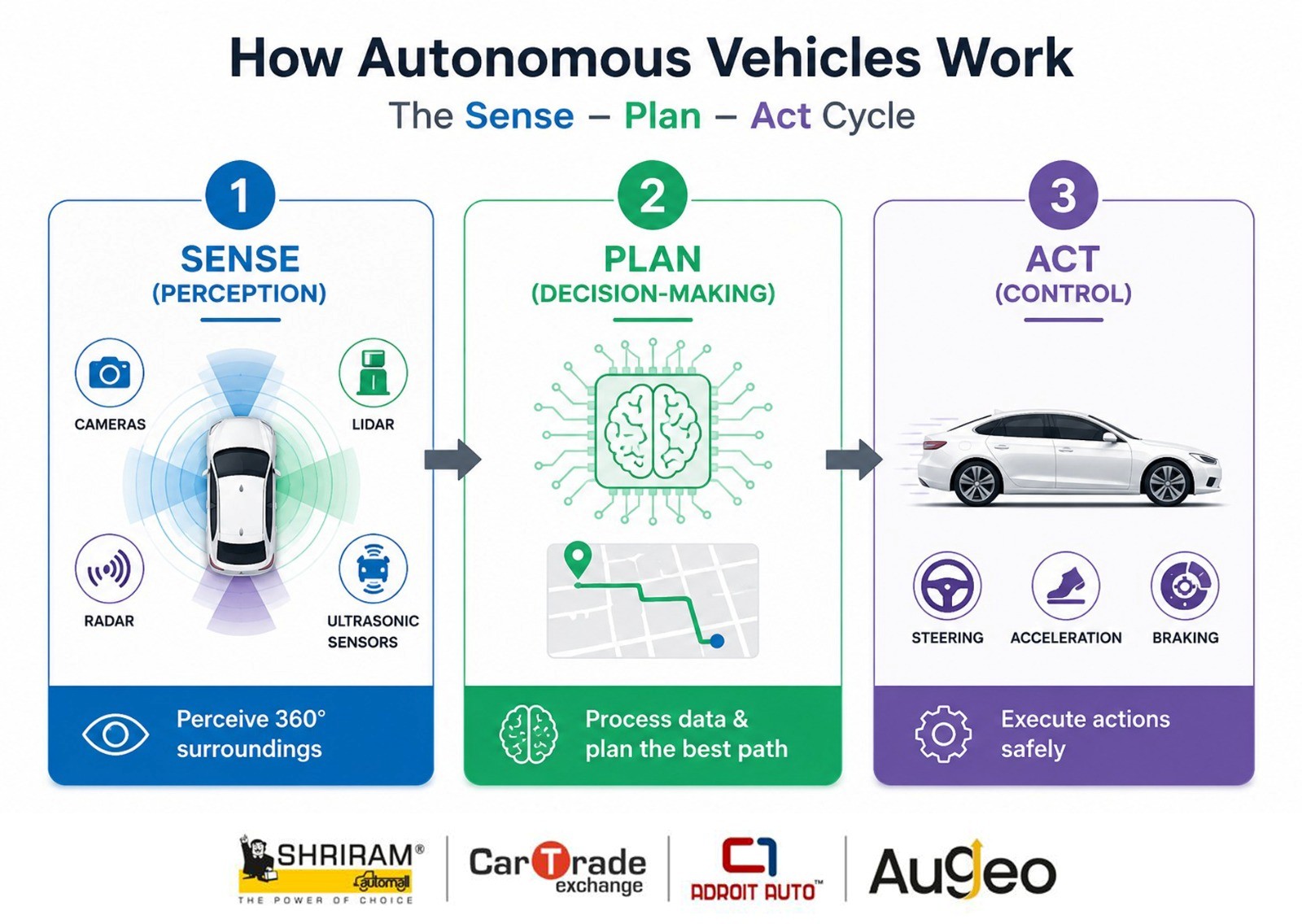
Autonomous vehicles work by mapping the environment and analysing traffic conditions continuously to steer, accelerate, and brake as needed. For measuring distances, detecting lane markings, and monitoring nearby vehicles, these vehicles use LiDAR and radar. Video cameras installed in the vehicles help detect traffic lights, read road signs, and watch for pedestrians. Lastly, to monitor blind spots, obstacles, and curbs for safety, perfect navigation is achieved by the sensors.
A continuous cycle of three steps- sense, plan, and act is run for the proper working of these autonomous vehicles. Sense means perception, plan means decision-making, and act means control. The image below shows the proper working of the three-step cycle:
What Are the 6 Levels of Autonomous Driving?
Autonomous vehicles are not all equally self-driving. To standardise the technology, the Society of Automotive Engineers (SAE) defines six levels of automation, ranging from Level 0 (fully human-controlled) to Level 5 (fully autonomous).
Below is a table explaining the 6 levels of automation in autonomous vehicles:
Level | Automation Stage | Human Involvement |
Level 0 | No Automation | The driver controls everything. |
Level 1 | Driver Assistance | Vehicle assists with steering or speed control. |
Level 2 | Partial Automation | The vehicle manages steering and speed, but the driver must stay alert. |
Level 3 | Conditional Automation | Vehicle drives itself in certain situations; the driver must be ready to take over. |
Level 4 | High Automation | Vehicle operates independently in specific areas or conditions. |
Level 5 | Full Automation | No driver needed; vehicle can operate anywhere, anytime. |
Autonomous Vehicles in India
The most common levels of autonomous vehicles on the Indian roads are level-2 and level-3 advanced driver assistance systems (ADAS). Fully autonomous vehicles remain far from Indias unpredictable traffic and poor infrastructure. There are many challenges that Indian roads offer, preventing level-4 and level-5 self-driving cars from entering the Indian market for now.
Let us look at some of those challenges:
- Pedestrians, stray animals, cyclists, and unorganized traffic conditions make it difficult for the AI systems to detect obstacles. The mixed and chaotic traffic on Indian roads is so erratic for the sensors since they are tested on structured roads.
- There is no lane discipline in India, along with poor road quality, potholes, and incomplete signage, which affects the navigation systems. The navigation relies on digital mapping and clear visual cues, which are unreliable on Indian roads.
- Due to the potential loss of jobs of the commercial drivers, the Ministry of Road Transport and Highways has kept the autonomous vehicles at bay.
- There is a lack of a unified legal framework specifically designed for autonomous vehicles. There are no provisions for these cars under the Motor Vehicles Act in India.
Startup Ecosystem for Autonomous Vehicles in India
Besides every challenge and obstacle, the autonomous vehicles are gaining a steady momentum within the startup ecosystem. Many homegrown startups have established the trend of autonomous vehicles in areas like industrial corridors, ports, campuses, and logistics hubs, where it is safe, and the ROI is good. On the policy front, NITI Aayogs National Strategy for AI identifies mobility as a priority, while the Smart Cities Mission and broader electric vehicle incentives create favourable conditions for pilot projects
Conclusion
The reality check came out to be that for India, in the near future, semi-autonomous vehicles can become a part of the roads. Because of all the factors about Indian infrastructure, traffic, government policies, etc, full autonomy is least expected, and is deemed unsafe. However, autonomous vehicles can become a part of the Indian mobility ecosystem over the long term with the convergence of electric vehicles, artificial intelligence, and shared mobility points.
The popularity of driverless vehicles is reshaping global transportation, but India stands at a crossroads. Semi-autonomous systems that support human drivers are likely to take centre stage, serving as a practical bridge towards fully autonomous mobility.
Frequently Asked Questions
1. What is an autonomous vehicle?
An autonomous vehicle is a self-driving vehicle that uses sensors, cameras, and AI to navigate and operate with minimal human input.
2. Are fully autonomous cars available in India?
No, fully autonomous cars are not available in India yet. Most vehicles currently offer only driver assistance features.
3. Why are self-driving cars difficult to implement in India?
Unpredictable traffic, poor road infrastructure, inconsistent lane markings, and regulatory challenges make autonomous driving difficult in India.
4. What is the future of autonomous vehicles in India?
Semi-autonomous vehicles are likely to become more common first, while fully autonomous vehicles may take much longer to become a reality.
 18001024141
 Download Our App