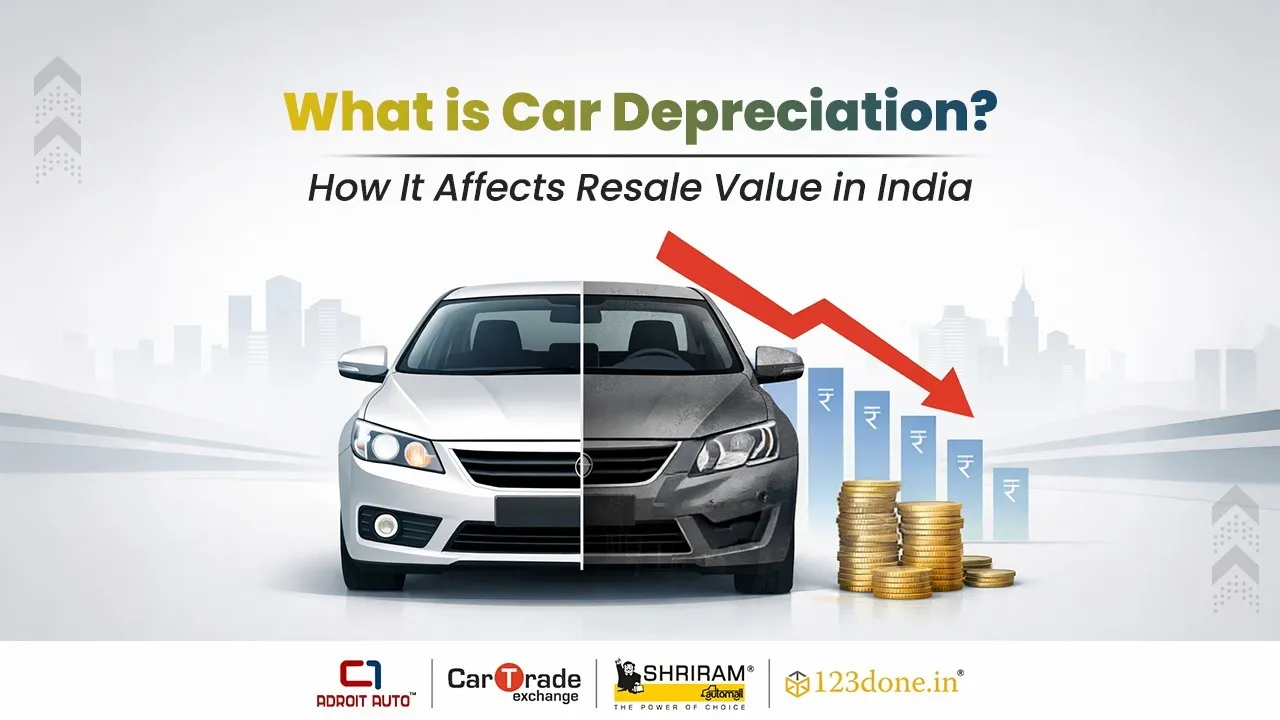
The reduction in the value of a car over time due to its usage, increased age, reduced mileage, and many other such factors is known as car depreciation. This car depreciation leads to the lowered resale value because of depreciation up to 20-30% during the initial year and then 10-15% annually. Car depreciation is highest during the first year and then gradually decreases based on the brand, maintenance, and demand. Well-maintained cars of reliable and famous brands lose value more slowly. Let us further look at how car depreciation affects resale value in India.
What is Car Depreciation
The loss of value of a car over time is known as car depreciation. As the years pass by, the cars lose a certain percentage of their value depending on their maintenance, brand, and condition. In India, for example, a car depreciates by 20-25% during the first year of purchase and then gradually comes down to 10-15%. Car depreciation happens the most during its initial time, whereas used cars of the same model might give you a higher resale value, as all the initial depreciation would have already taken place.
In India, the Insurance Regulatory and Development Authority of India (IRDAI) has laid down standard depreciation rates to ensure transparency and fairness in motor insurance. These rates are used to calculate a vehicle’s Insured Declared Value (IDV), which ultimately decides how much compensation an owner receives in case of theft or a total loss. The depreciation percentages approved by IRDAI vary according to the age of the vehicle and are as follows:
|
Vehicle Age
|
Applicable Depreciation
|
|
Up to 6 months
|
5% depreciation
|
|
Above 6 months up to 1 year
|
15% depreciation
|
|
Above 1 year up to 2 years
|
20% depreciation
|
|
Above 2 years up to 3 years
|
30% depreciation
|
|
Above 3 years up to 4 years
|
40% depreciation
|
|
Above 4 years up to 5 years
|
50% depreciation
|
|
More than 5 years
|
Depreciation is mutually decided by the insurer and policyholder
|
This refers to the depreciation rate of new cars, whereas for used cars, depreciation is not fixed. The depreciation of used cars depends on various factors, including the brand, model, fuel type, and demand. Some cars have high resale value, and hence, the depreciation rates of such cars are lower. The depreciation of luxury cars is very high, which makes the rates of second-hand luxury cars lower and slightly more affordable.
How to Calculate Car Depreciation
Using simple maths, you can easily calculate your car’s depreciation over time. As per IRDAI, car depreciation is calculated by subtracting the depreciated value based on the car’s age from the original ex-showroom price.
For example, if the ex-showroom price of the car was Rs 12,00,000, and the depreciation rate for 2-3 years is 30%. Then, 30% of Rs 12,00,000 is Rs 3,60,000, which, when we subtract from the initial price, is Rs 8,40,000. Hence, the current value of a car, which is 2-3 years old with an ex-showroom price of Rs 12,00,000, is Rs 8,40,000.
What Affects Car Depreciation in India
Car depreciation is influenced by a few factors which affects the resale value of cars in India. Let us look at the factors that affect car depreciation in India:
-
The older the car, the more depreciation takes place. Depending on the kilometres driven, car depreciation varies.
-
Reputed brands go through less depreciation over time, and the more the demand, the less the depreciation is.
-
The better the condition, the less the car depreciation. Based on the service records of the car, depreciation may vary.
-
Cars with a diesel engine go through depreciation faster.
-
The fewer the number of previous owners, the better the value of the car.
To minimize car depreciation and acquire a better resale value in India, be sure to choose a reliable car brand and model. Like, cars from Maruti Suzuki or Hyundai go through less depreciation. Car service records are very useful in deciding your car’s resale value. Maintain your car as time passes, as this can lead to less car depreciation. Keep the car mileage down by driving consciously and calmly.
How Car Depreciation Affects Resale Value in India
In India, car depreciation reduces a car’s value drastically up to 15-20% or even up to 25% annually in the first few years. Car depreciation, however, reduces after some time and slows down depending on its age, condition, mileage, brand, demand, fuel type, etc. The resale value in India is also dependent upon the maintenance of the car and emission norms (BS6). Due to high demand, cars from Maruti Suzuki and Hyundai depreciate more slowly. Cars with lower mileage and good service history have a better resale value. New BS6 norms make older cars face more depreciation. Due to market trends, SUVs retain their value better than sedans in the first few years. Car depreciation is also influenced by fluctuating buyer demand.
How to Minimize Car Depreciation and Retain Resale Value
Car depreciation is inevitable, and no one can stop it. There are certain ways in which you can minimize it. Let us take you through the steps to follow for retaining your car’s resale value:
-
Make sure that you choose the car brands that are very popular and reliable, because their demand will never be out, which will make car depreciation slower.
-
Regular car servicing ensures that no wear or tear happens and your car has a clean, healthy history.
-
Make sure that the paint of your car is protected and seats are well-maintained. Ensuring that you park your car in safe areas will protect its exterior parts.
-
For any part replacement or future repairs, make sure that you take zero depreciation car insurance to maintain your car’s resale value.
Conclusion
Car depreciation affects both buyers and sellers alike. For making an informed decision to buy used car or a new car, and selling a car, all needs to be done with full knowledge. Car depreciation affects the resale value of that car highly, and knowing how to prevent it, what car depreciation really is, and what all you can do to prevent car depreciation can help you purchase the best possible option in India.
Frequently Asked Questions (FAQs)
1. How much does a car depreciate in the first year in India?
In India, a new car typically depreciates by 20–25% in the first year itself. This is the steepest drop in value due to factors like registration, initial usage, and market perception. After the first year, depreciation slows down to around 10–15% annually, depending on the car’s condition, brand, and demand.
2. Which cars have the lowest depreciation and best resale value in India?
Cars from reliable and high-demand brands like Maruti Suzuki and Hyundai generally have the lowest depreciation in India. Models with strong after-sales support, good fuel efficiency, and widespread service networks tend to retain better resale value, especially in the used car market.
3. Does car insurance depreciation affect resale value?
Yes, car insurance depreciation indirectly affects resale value. The Insured Declared Value (IDV) is calculated using IRDAI depreciation rates and reflects the car’s current market worth. Choosing zero depreciation insurance helps maintain the value of replaced parts, keeping the car in better condition and improving its resale potential.
4. How can I reduce car depreciation and get a higher resale price?
You can reduce car depreciation by servicing your car regularly, keeping mileage in check, maintaining proper service records, and protecting the exterior and interior. Opting for popular models, avoiding major modifications, and complying with emission norms (like BS6) also helps you secure a higher resale value in India.
 18001024141
 Download Our App