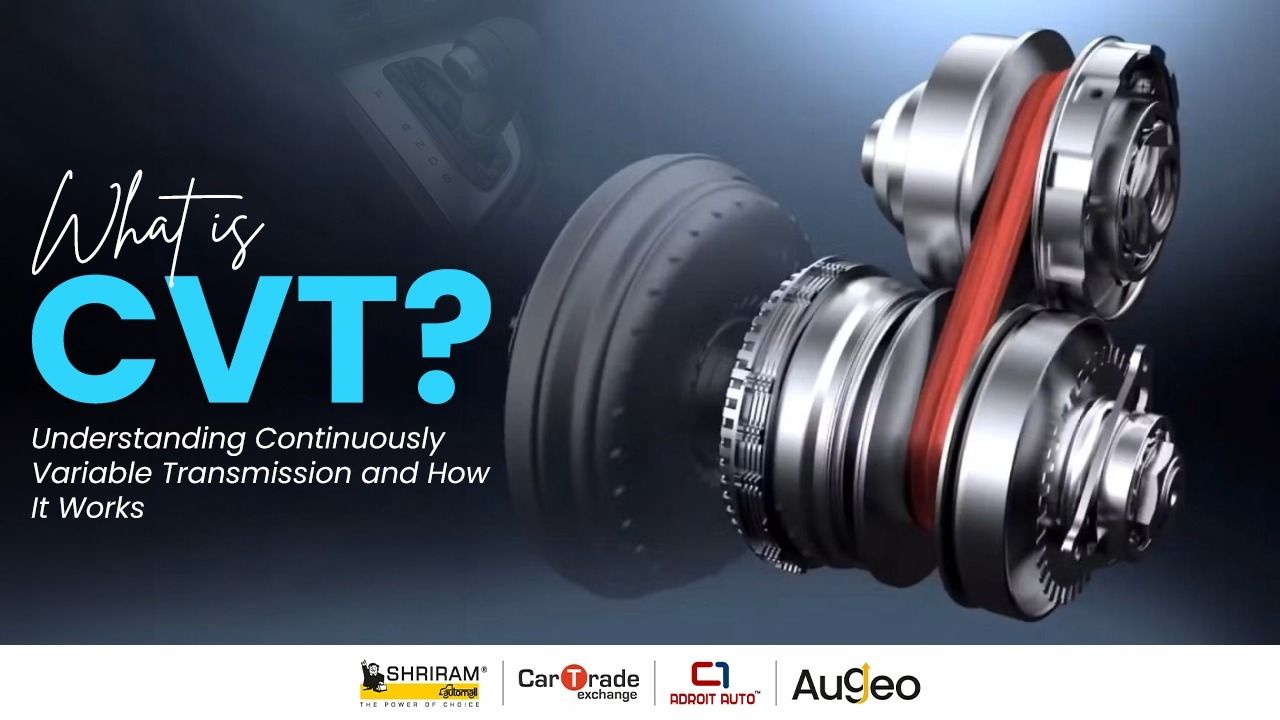
A CVT transmission, or Continuously Variable Transmission, is a kind of automatic transmission that never uses fixed or physical gears. Variable-diameter pulleys are used instead of shifting gears, which are connected to a belt providing an infinite range of gear ratios. CVT maximizes the fuel efficiency and delivers smooth acceleration, which keeps the engine at an optimal RPM. CVT works by using a system of variable-diameter pulleys that are connected with a chain or high-strength belt.
This blog will reveal further what a CVT transmission is and how the continuously variable transmission (CVT) works.
What is a Continuously Variable Transmission or CVT
A CVT, or continuously variable transmission, is a type of automatic transmission that is the simplest of all. There are variable pulley diameters, which are unique compared to other automatic transmissions like an automated manual transmission (AMT), a dual clutch transmission (DCT), or a torque converter, for that matter. When it comes to providing a smooth and efficient drive, CVT transmission is considered the best.
For every situation, the CVT transmission relies on a transmission control unit, which reads data from multiple sensors. The sensors determine optimal pulley configuration at any particular instance to ensure a smooth and efficient working of the vehicle.
How CVT Transmission Works
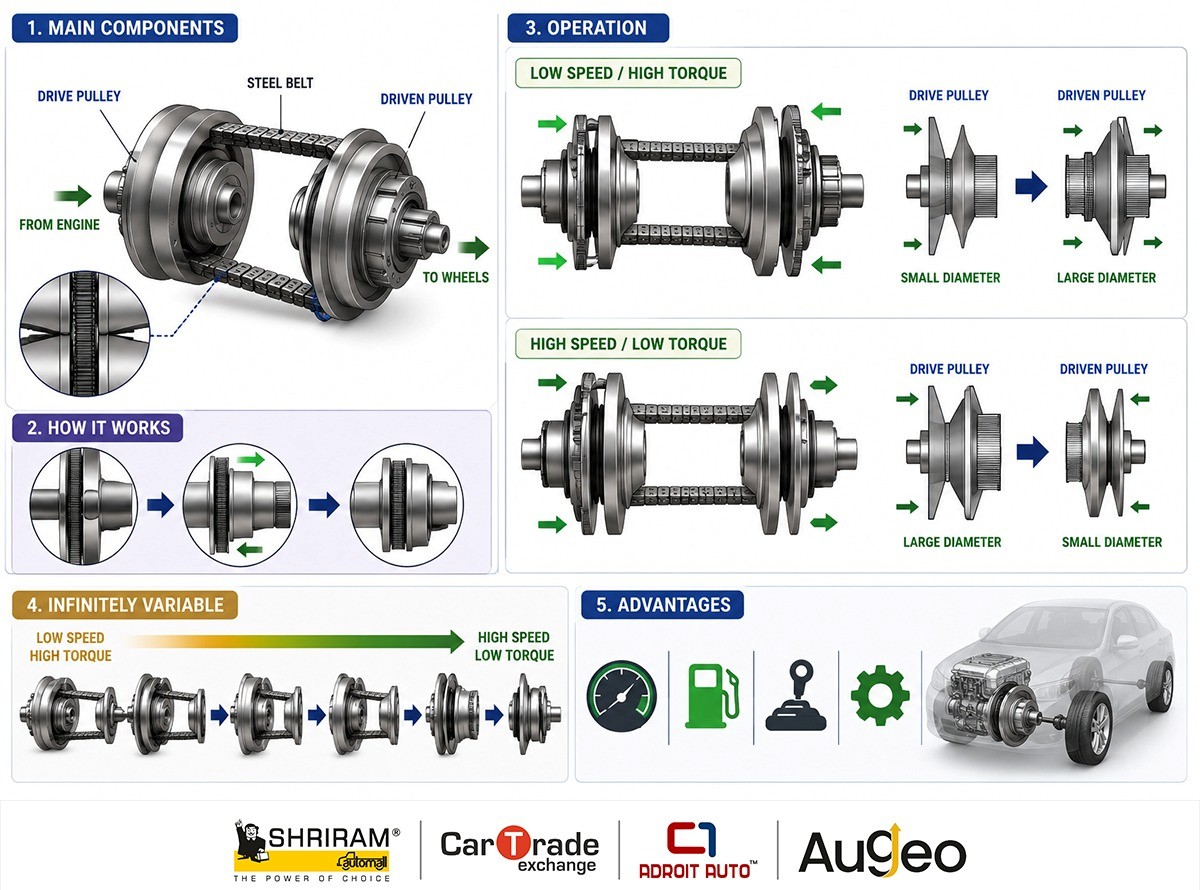
The continuously variable transmission (CVT) works with a system of belts and variable-diameter pulleys, which provide an infinite range of gear ratios. There are three important components of CVT. First is the input pulley, which is connected to the engine and is basically the driving part. Second is the output pulley, which is connected to the wheels and is basically the driven part. Lastly, there is a belt of chain, which is a high-strength metal belt wrapping both pulleys together.
There are sheaves or con-shaped halves that make up a pulley. There are two of them that face each other at an angle. They move closer or farther to each other, making the belt ride higher or lower. Let us now see how the gear ratios change with the help of the pulley:
- When the engine sheaves are far apart, and wheel pulleys are closer together, it creates a high torque, making the car move easily. This means that the vehicle is in low gear and starting from a stop.
- When the sheaves are closed together, and the wheel pulleys are far apart, it allows the vehicle to travel at high speeds and maintain the RPM efficiency.
Why is Continuously Variable Transmission Used
CVT vehicles are more efficient because the constant adjustment of the pulley width helps the vehicle stay within its optimal power band. The vehicle's mileage is therefore higher than that of traditional geared automatics. In addition to this, the CVT provides a seamless acceleration as there are no shift rocks. The transmission never disengages gears, and hence, there are no interruptions while driving.
Because a CVT is designed to keep the engine operating at its most efficient speed, you may notice the engine revving steadily while the vehicle continues to gain speed. The sensation that is felt is known as the rubber band effect. In this, the sound of the engine is fairly louder than ones expectations, which makes the acceleration feel slightly delayed. So, many CVTs that are being manufactured now come with simulated gear shifts.
CVT in Cars and Equipment
CVT transmission is used widely in manual, automatic, and hybrid cars since it provides excellent fuel efficiency. The cars that are equipped with CVT are best for daily commuting. Scooters and motorcycles also use this transmission for seamless throttle response in small engines. This also eliminates the need for manual clutch and gear shifting. Lastly, CVT is used in recreational vehicles like ATVs, snowmobiles, or UTVs for instantly adjusting to variable terrains.
If we talk about industrial equipment, then tractors and heavy mowers use CVT for precise speed control and uninterrupted loading. Agricultural and earthmoving machinery used a continuously variable transmission for precision.
Conclusion
The Continuously Variable Transmission has seriously transformed the performance and comfort of modern vehicles. The fuel efficiency that the CVT vehicles provide is way beyond that of traditional transmission vehicles. CVT offers seamless acceleration by continuously adjusting the gear ratios, unlike traditional automatic gears. Whether you're driving through city traffic, cruising on highways, or looking for better mileage from your vehicle, a continuously variable transmission can provide a smoother and more economical driving experience.
Understanding what a CVT is and how CVT transmission works becomes important as many automotive companies are using it now. The driving experience may differ a bit from the traditional automatic vehicles, but the increased comfort, fuel efficiency, practicality, etc., make CVT transmission a hit.
Frequently Asked Questions (FAQs)
1. What is a CVT transmission in a car?
A CVT (Continuously Variable Transmission) is an automatic transmission that uses pulleys and a belt instead of fixed gears, allowing smooth and efficient acceleration.
2. Is a CVT better than a traditional automatic transmission?
A CVT is generally better for fuel efficiency and smoother driving, while traditional automatics may offer a sportier and more familiar driving feel.
3. Why do CVT cars feel different when accelerating?
CVT-equipped cars keep the engine at an optimal RPM, which can make the engine sound louder while the vehicle gradually gains speed.
4. Which vehicles commonly use a Continuously Variable Transmission (CVT)?
CVTs are commonly found in compact cars, hybrid vehicles, scooters, motorcycles, and some agricultural and industrial machines.
 18001024141
 Download Our App